

PUMP for Nursing Mothers Act Passes with Bipartisan Support in U.S. House of Representatives

WorkLife Law Launches Dar a Luz to Empower Farmworkers in Pregnancy and Postpartum
 In 2019, WorkLife Law advocated with California’s Employment Development Department (EDD), which administers the state’s worker-funded State Disability Insurance (SDI), to ensure that farmworkers could access critical paid leave early in pregnancy. Dar a Luz, a collaboration with the Central Coast Alliance United for a Sustainable Economy (CAUSE), continues this critical effort to support and empower farmworkers who need paid time off work to avoid harmful exposure to agricultural toxins during pregnancy, and the postpartum and nursing period.
New Toolkit on Centering Pregnant and Parenting Students in the Transition Back to Campus
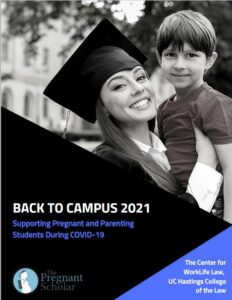 As the U.S. heads into the second fall of the COVID-19 pandemic, millions of student parents enrolled in college are returning to in person instruction at the same time as their children. The new toolkit from the Center for WorkLife Law’s Pregnant Scholar Initiative offers concrete guidance on how to return to on-campus instruction in a way is inclusive of pregnant and parenting students.
WorkLife Law’s Summer Research Assistant
 This summer, UC Berkeley student Kybeth Ruiz-Gaytan joined the Center for WorkLife Law team as a research assistant. Kybeth investigated current employer policies and employee needs, which culminated in the creation of our new Toolkit for Centering Equity in the Transition to Hybrid Work. She also added to the Center’s research database by conducting literature reviews focused on how bias plays out for individuals in the LGBTQIA+ community and people with disabilities.
WorkLife Law’s Mark Hart Fellow
 This summer, Loyola Marymount University student Kylie Francisco joined the Center for WorkLife Law team as our Mark Hart Fellow. Working with, Director Joan C. Williams, Kylie investigated the impact of race and social class in recent presidential elections, with a particular focus on comparing the voting patterns of college-educated and non college-educated voters. Her analysis of polling data and qualitative studies over the last three months provide enormous insight on why class matters in today’s political climate. This opportunity would not have been possible without the generous contribution of the Mark Hart Fellowship.
WorkLife Law’s Ruth Bader Ginsburg Fellow
 This summer, University of Pittsburgh student Olivia Andrews worked as Center for WorkLife Law’s Ruth Bader Ginsburg Fellow. Olivia examined gender bias in the field of cardiology and analyzed the patterns of discrimination that pregnant cardiologists face in the workplace. She also investigated the role that gender, race, and class discrimination play in the finance sector in order to explain the lack of diversity within the industry. Olivia’s work has been made possible thanks to the distinguished Ruth Bader Ginsburg Fellowship.
New Toolkit for Centering Equity in the Transition to Hybrid Work
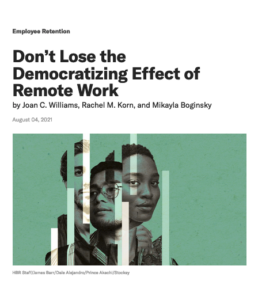 Mishandling the transition to hybrid work threatens to reinforce social inequalities and jeopardize companies’ diversity, equity, and inclusion (DEI) efforts. Read more in our latest Harvard Business Review article, “Don’t Lose the Democratizing Effect of Hybrid Work” and check out our new toolkit with A Better Life Lab for concrete guidance on how to ensure an equitable transition to hybrid work.
New report- “Litigation or Clarification? The Impact of Family Responsibilities Discrimination Laws”
 Our newest report, “Litigation or Clarification? The Impact of Family Responsibilities Discrimination Laws” explores whether and to what extent family responsibilities discrimination laws increase litigation against employers. Our research shows that the passage of such laws does not meaningfully increase litigation rates.
New Report: Compliance or Complaints? The Impact of Private Enforceability of Lactation Break Time and Space Laws
 Our latest report, “Compliance or Complaints? The Impact of Private Enforceability of Lactation Break Time and Space Laws” investigates whether the federal PUMP for Nursing Mothers Act, if passed, would lead to a landslide of litigation against employers. Our new research shows it would not.
Our Latest Op-Ed: California Should Protect the Work Rights of Family Caregivers

Read our latest op-ed in the Los Angeles Times on why California Assembly Bill AB1119 is imperative for workers with family responsibilities.